



- Knowledge Base
- |
- Construction Ideas
- |
- Construction Market Trends
- |
- Industrial Construction Market Trends
Four Questions to Help Wisconsin Manufacturers Evaluate Facility Expansion in 2026
Manufacturing remains the largest contributor to Wisconsin’s economy, generating more than $70 billion in revenue annually. The state also consistently ranks among the top in the nation for the share of manufacturing jobs.¹
These numbers showcase the demand. But what they don’t tell you is whether your current facility is ready to capture that growth. With Wisconsin’s current tax environment creating meaningful incentives for capital improvements and expansion, many manufacturers are finding it to be a good time to evaluate their next move.
For operations leaders and plant managers, the right time to expand becomes clear when facility bottlenecks and inefficiencies begin to erode the ability to meet customer demand.
Here are four questions Wisconsin manufacturers should evaluate as they consider their next move.
1. Is growth outpacing your facility’s design?
When Saputo Cheese USA, one of the world’s largest dairy processors, experienced a major sales increase driven by America’s growing demand for cheeseburgers[1], the company recognized the need for greater operational efficiency and opened a new 311,000-square-foot cold-storage and distribution facility in Caledonia Corporate Park.[2]
Demand like this is a good problem to have. But when growth begins to strain labor, space, and systems, your facility may be operating beyond its intended design capacity. Remember that expansion should really be more about redesign that enhances productivity and efficiency, not just adding square footage.
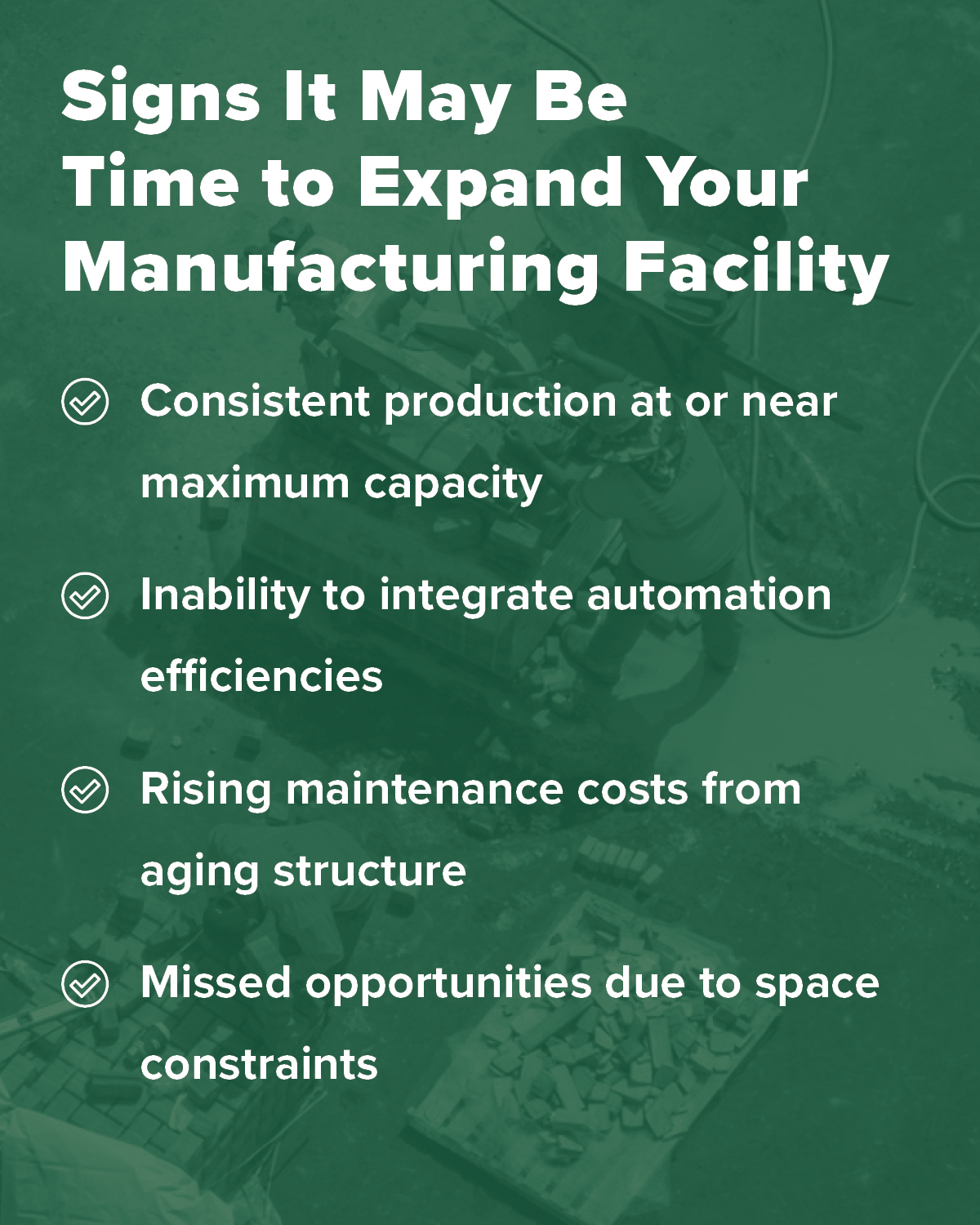
Questions manufacturing leaders should consider:
- Are we consistently running near or at maximum capacity?
- Are we delaying new contracts due to space or operational constraints?
- Have incremental efficiency gains become harder to achieve?
- Is aging infrastructure driving up maintenance costs?
If the answer is yes, it may be time to identify pressure points and begin an expansion planning discussion before they become bottlenecks.
2. What’s the hidden cost of waiting to expand?
Construction costs, interest rates, and government policy are constantly shifting. Delaying a facility expansion can feel financially smart in an unpredictable economy. But what looks like savings on a balance sheet may be revenue slipping through the cracks. High-margin opportunities are missed, and over time, maintenance and workflow inefficiencies drive up operating expenses. Longer lead times also open the door for competitors to gain your market share.
Temporary fixes during high-demand periods can also result in many issues, such as patched equipment lowering production speeds, temporary manual processes causing errors, and crowded layouts hindering flow.[3]
When companies wait until capacity issues become urgent, they can lose negotiating leverage, flexibility, and revenue potential.
Ask:
- What revenue are we unable to capture at our current capacity?
- What is the financial impact of operational efficiencies due to our current layout?
- What strategic advantages are we missing by waiting?
3. Do our automation needs require a new space?
Automation, robotics, and smart manufacturing are active investment priorities across Wisconsin. But many facilities were designed decades ago around labor-intensive workflows. Retrofitting automation into a building that lacks clear height, open spans, sufficient floor loads, or adequate electrical capacity can quickly erode ROI.
Ask:
- Does our ceiling height support robotics or vertical storage systems?
- Is our electrical service sized for future automation?
- Are we planning around yesterday’s processes instead of tomorrows?
If your technology strategy is ambitious but your building is restrictive, expansion may be the more efficient long-term investment.
4. Do Incentives and Market Conditions Align?
Operational readiness is only part of the equation. Executives evaluating capital improvements may find that 2026 presents valuable Wisconsin tax incentives that could impact expansion plans.
- For 2026, Wisconsin commercial construction, new federal legislation passed in July 2025 restores 100% bonus depreciation, raises Section 179 expense limits, and offers a new 100% deduction for “qualified production property” for manufacturing-related construction.
- Wisconsin’s Manufacturing & Agriculture Credit can materially lower the effective state tax rate on qualifying manufacturing income. For example, the credit may be claimed on 7.5% of the state’s flat 7.9% corporate income tax rate or the top personal income tax bracket of 7.65%. leading to an effective rate of 0.4% or 0.15%, respectively, for manufacturers who produce in Wisconsin.[4]
- Wisconsin’s personal property tax repeal took effect January 1, 2024, eliminating personal property taxes on business personal property (including machinery/equipment) statewide.[5]
Your tax consultant should advise as to the most favorable tax policies for your business and the Riley team always plays a collaborative role with financial experts to evaluate eligibility.
When reviewing a potential expansion, early collaboration provides clarity around scope, cost, and timeline. Riley Construction has partnered as a construction manager with many Wisconsin-based companies in food processing, industrial production and advanced manufacturing to design and manage facility expansions for long-term operational needs.
If your team is evaluating capacity constraints, automation upgrades or long-term facility growth, start a facility expansion planning conversation with Riley Construction.
[1] https://ca.finance.yahoo.com/news/more-cheese-on-fast-food-menus-and-protein-craze-are-wins-for-canadas-dairy-giant-saputo-ceo-151411716.html
[2] https://rcedc.org/partnership-drives-new-saputo-facility-in-caledonia/
[3] https://vidyatec.com/blog/when-temporary-repairs-are-the-smart-move/#:~:text=Why%20Do%20Temporary%20Repairs%20Happen,further%20degradation%20or%20unsafe%20conditions.
[4] https://www.wmc.org/issues/facts-about-the-manufacturing-agriculture-credit/
[5] Wisconsin Department of Revenue
