


- Municipal Construction Market Trends
- |
- Knowledge Base
- |
- Municipal Construction Market Trends
Renovate or Rebuild? What Every Municipality Should Ask Before It’s Too Late
A practical guide for public works directors and village leaders on evaluating aging police stations, fire stations, and public buildings.
| KEY TAKEAWAYS ∙ Aging facilities carry hidden costs including energy waste, deferred maintenance, and code gaps that annual budgets rarely capture. ∙ Adaptive reuse with phased construction can deliver modern functionality at manageable cost. ∙ The best time to evaluate is before a failure forces the decision. Proactive assessment expands options and controls cost. |
Most public works directors know when a building is overdue for attention. The leaking roof. The outdated HVAC. The locker room untouched for decades. What’s harder is answering what comes next: do we fix what’s there, or start over?
Riley Construction has helped municipalities navigate this decision dozens of times across Wisconsin and Illinois. Here’s how we think about it.
Why Do Aging Facilities Cost More Than They Appear To?
Annual maintenance budgets rarely reflect the true cost of an aging building. Boards approve incremental repairs year after year without seeing the cumulative picture. The costs that don’t show up in the maintenance line:
- Energy inefficiency. Pre-modern buildings routinely consume two to three times the energy of comparable new construction.[1]
- Code compliance gaps. Renovations trigger life safety, ADA, and building code requirements that can dramatically expand scope and cost.[2]
- Functional obsolescence. A fire station built for older apparatus may not fit modern vehicles. A police facility from decades ago may lack evidence storage, interview rooms, or current holding requirements.
- Deferred maintenance liability. Water intrusion damages structural systems, aging equipment fails, and emergency repairs cost far more than planned capital investment.[3]
The right question isn’t what the building will cost next year, but what it will cost in its full life cycle compared with a planned capital solution.
How do you know whether to renovate or rebuild?
Renovation is often the right path when:
- Existing structure is sound with little to no deterioration, and core systems have remaining life.
- The site and footprint genuinely serve the community’s long-term needs.
- Renovation delivers comparable long-term value at a lower upfront cost.
Rebuilding is often the right path when:
- Renovation costs approach 60% of replacement cost. At that threshold, new construction typically wins.[4]
- The building can’t be made to function well: floor plates won’t reconfigure, ceilings are too low, or the site can’t expand.
- Environmental hazards (asbestos, lead) substantially increase renovation complexity.
- A new location offers faster response times, better access, or aligns with community growth.
What happens when a good solution seems impossible?
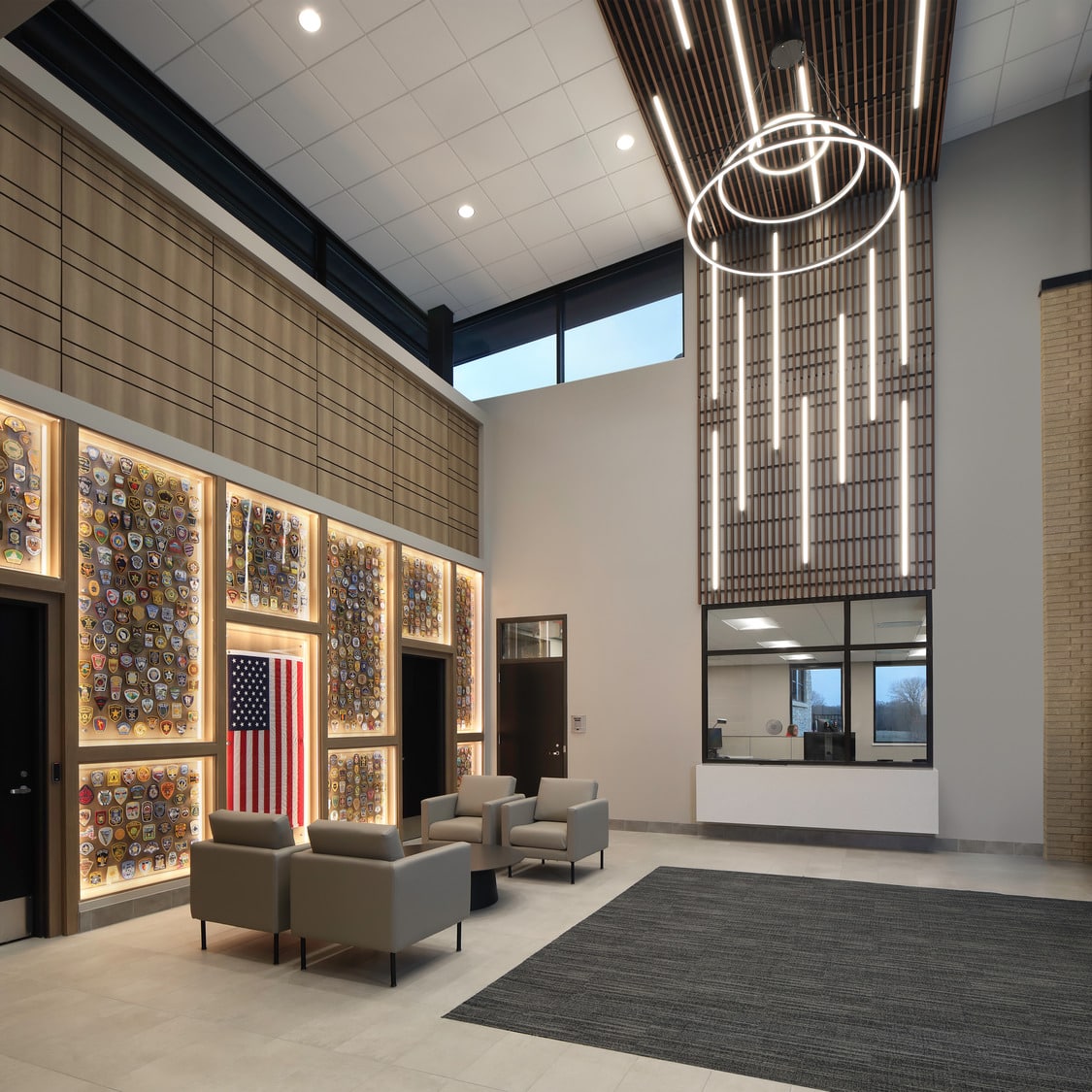
When renovation seems impossible and rebuilding isn’t feasible, adaptive reuse with phased construction is often the answer. The Shorewood Police Department project is a good example.
The Village purchased a former office building to replace a 1920s-era headquarters which featured a Village Hall basement where a cloakroom with an iron cage served as the lock-up. The problem: the building lacked evidence staging, interview rooms, a vehicle garage, and a wash station. Riley developed a three-phased plan that kept the department fully operational throughout construction, ultimately delivering a 28,620-square-foot purpose-built headquarters – more than five times the original square footage. Phased delivery spread the cost across fiscal years and kept the project viable.
What should you do before the building forces the decision?
The most expensive time to evaluate a facility is after a failure. By then, options narrow and emergency costs take over. The better approach:
- Commission a facility assessment to establish structural condition, system life expectancy, code gaps, and environmental hazards.
- Build an accurate cost model. Compare cumulative maintenance costs against the amortized cost of renovation or new construction.
- Bring in a construction manager with a design firm. A CM provides logistic expertise and phasing ideas along with real-world cost data at the design stage. This is crucial before the municipality is committed to a direction.
Riley Construction has more than 60 years of experience helping Wisconsin and Illinois municipalities make sound capital decisions on aging public facilities. Choosing a Construction Manager is hard, we’ve made this guide to help you make your decision.
To start a conversation, visit Riley’s municipal services page or contact Project Executive Chad Parker at ChadP@rileycon.com or Project Executive Dan Sullivan at dsullivan@rileycon.com.
[1]https://www.nature.com/articles/s42949-025-00298-6
[2]https://www.facilitiesnet.com/ada/article/Renovations-Trigger-ADA-Compliance–12478
[3]https://www.pew.org/en/research-and-analysis/articles/2025/12/19/strategies-for-deferred-maintenance-in-state-owned-buildings
[4]https://www.twobillsdrive.com/2021/11/05/why-consultants-say-a-new-stadium-makes-more-sense-than-renovating-highmark-stadium/
